
Most businesses I work with already have plenty of information. There are website reports, sales figures, customer records, campaign results and project boards. People are collecting data every day. The difficulty is getting those pieces together while there is still time to do something useful with them.
That is where our work with AI agents for business has become interesting. We have been developing workflows that bring existing information together, check what has changed and prepare a clearer picture for someone to act on. The progression is simple: data → context → insight → decision → action. Each step has to earn its place.
The Problem Isn't Always Data. It's Time to Insight
A customer buys less than they used to. A useful search page starts losing visibility. A request arrives by email but never makes it onto the project board. None of those events necessarily creates an immediate crisis. Left unnoticed, though, each can become a missed opportunity or a problem that takes more effort to put right.
The information may already exist. It is just sitting in different places, waiting for somebody to find it, export it, compare it and explain it. By the time the monthly report arrives, the business might be looking at something that started several weeks earlier.
An AI agent is a system designed to perform defined tasks using business data, tools and rules. In the workflows we are developing, that means gathering relevant information, identifying changes, adding context and bringing the result to the person who needs it. What it can do depends on its connections, permissions and instructions.
For me, the useful question is how much sooner we can reach a decision that matters. A faster summary is helpful only if it makes the underlying issue easier to understand. That is why our approach to AI agent development starts with a business process and an agreed output.
Connecting the Dots
Take a trade-account application. Viewed on its own, it looks like a new prospect that needs qualification. Add purchasing history and you might discover that several people from the same company have already bought from the business. Add CRM and invoice records and the company might already have an active account.
Those are different conversations. One is about introducing the business. Another is about consolidating an existing relationship. Another is about helping an established customer use a wider range of services. Treating all three as a new lead wastes context that the business already holds.
We have developed an agent workflow that compares account applications, purchasing information and CRM records to help establish that context. The output separates recorded facts from possible opportunities and questions that still need checking. It prepares a starting point for sales follow-up rather than assuming that a match between two records proves everything.
This is where business data integration becomes valuable. Bringing records together is only the beginning. The agent also needs rules for matching companies, recognising incomplete information and flagging contradictions. Similar names, shared email domains and different dates all deserve care. A confident paragraph should never hide an uncertain match.
From Reporting to Early Warning
Regular reporting still has an important job. It lets us review trends, understand the wider position and decide whether the strategy needs to change. AI reporting tools can complement that work by helping us notice meaningful changes between formal reviews.
Our commercial review work has brought purchasing and account information into segments, watchlists and opportunities for review. That can give a team a more focused starting point for investigating falling spend, product categories that have stopped selling to an account or customers who may be worth re-engaging.
A reduction in spend is a signal, not an explanation. The customer might be buying less, purchasing somewhere else, working through existing stock or ordering through another account. The useful output identifies the change, shows the evidence and suggests the questions a person should ask next.
The same principle applies to marketing performance. A fall in impressions, clicks or enquiries can warrant attention, but a small change on a low-volume page is not necessarily important. Comparisons need an appropriate period, enough data and a measure connected to the business objective.
Removing the Reasons and the Excuses
We have all heard some version of the same explanation: the data is in another system, the report has not been pulled, somebody is waiting for an update or there has not been time to look properly. Sometimes those are real constraints. Sometimes they become a routine reason for delaying a decision.
Connecting the information can reduce the time spent assembling the picture. An agent can prepare the relevant records, make a comparison and identify what is missing. The conversation can then move from finding the information to deciding what to do with it.
There is an operational example here too. We have used an agent workflow to compare incoming email requests with documents and project tasks. A request can exist in an inbox without a corresponding card on the board. Bringing those sources together helps make that gap visible before everyone assumes somebody else is handling it.
Visibility does not complete the task. Someone still needs to confirm the request, assign the work and agree a deadline. But it makes ownership easier to discuss. When the evidence and the gap are in front of the team, there is less room for a missed request to disappear into the space between systems.
One Business, Multiple Data Streams
AI agents for marketing can work across different sources where appropriate integrations and permissions exist. Each source contributes a different part of the picture:
- GA4: how visitors arrive and what they do on the website.
- Google Search Console: the searches and pages generating visibility and clicks.
- Advertising platforms: campaign activity, costs and recorded outcomes.
- CRM data: enquiries, relationships, follow-up and pipeline status.
- Sales systems: purchases, invoices and customer buying patterns.
- Workflow tools: the work underway, approvals and delivery issues.
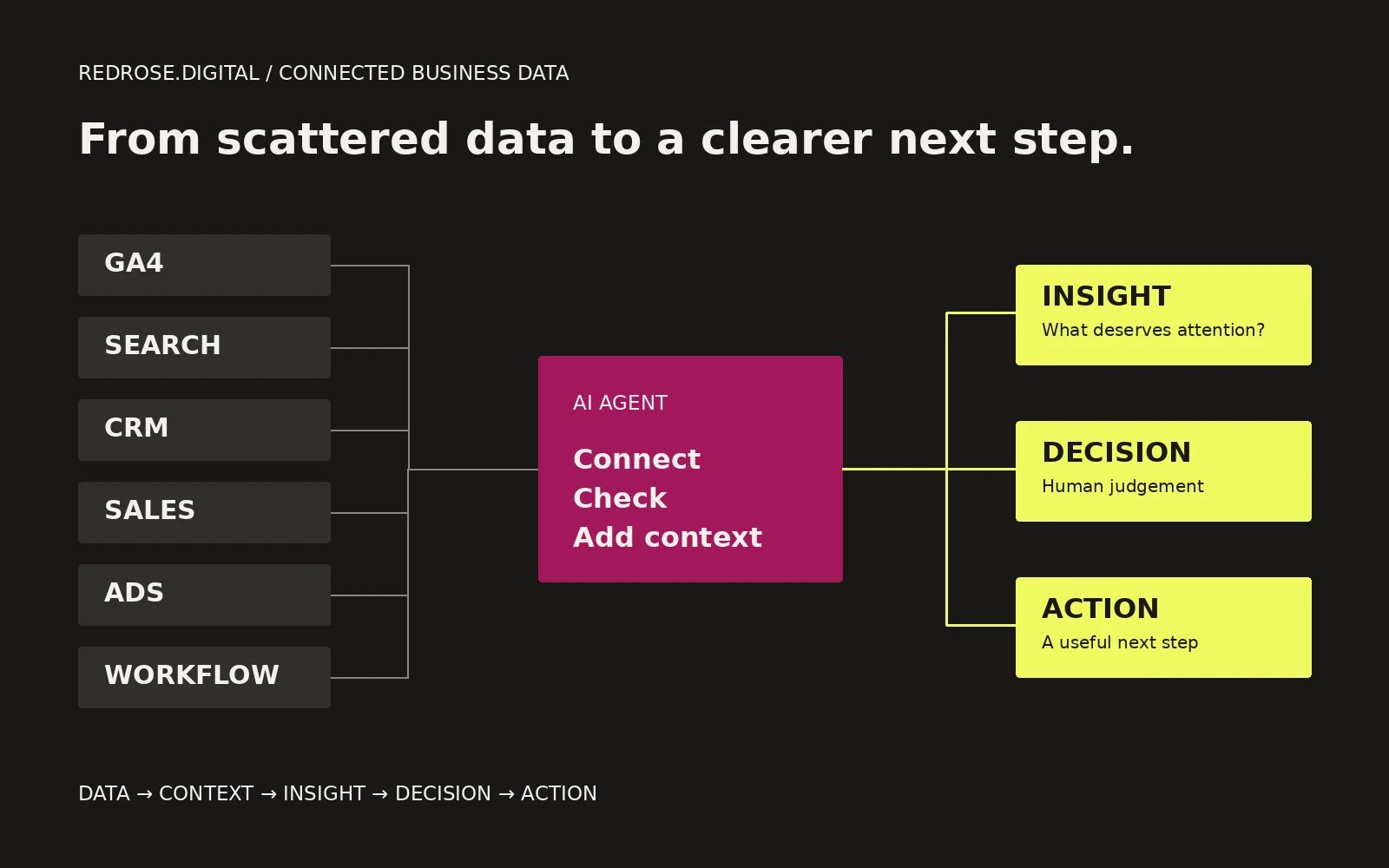
These systems do not always describe the same event in the same way. A website conversion is not automatically a qualified lead. A CRM opportunity is not an invoice. An open project card might describe work that is already published. Good AI marketing reporting needs to respect those differences.
Our CRM guide for SMEs looks at some of the systems businesses use to manage customer information. Whatever the platform, an agent needs to know which source is authoritative for each question. It also needs to make clear when a connection, date range or missing record limits the answer.
We have built and tested workflows using particular combinations of these sources. That does not mean every business has every connection ready to go. Access, data quality and the question being asked shape what is practical.
Getting to the Question Sooner
The best output often gives you a sharper question. Which accounts have changed their purchasing pattern? Which search pages have lost visibility? Which requests are still waiting to become tasks? Which projects need a decision before work can move on?
We have tested a Search Console review agent that compares page performance across periods and highlights gains, losses and possible next actions. We have also developed Trello reporting workflows that distinguish activity during the reporting period from the current position of the board.
That distinction matters. A card being in a completed list does not prove it was completed this week. A page improving in average position does not necessarily mean it generated more valuable traffic. The agent should help us get to those questions, with links or references that allow a person to check the finding.
A useful review identifies the signal, adds the available context and makes the next step clear. It can also say that there is not enough evidence yet. That is more useful than creating a long list of confident recommendations from weak information.
AI Shouldn't Replace the Decision
Agents can be designed with different levels of autonomy. Our approach is to use them to surface information and context so people can make better-informed decisions. The team remains responsible for deciding what the evidence means and what action fits the business.
A proposed account opportunity is a judgement. Recorded purchases are evidence. An agent needs to keep those separate. Sales teams may know about a relationship, a procurement arrangement or a recent conversation that has not reached the connected systems. That knowledge can change the recommendation.
We also agree what the workflow is allowed to do. Reading a board and drafting a report is different from moving cards or contacting customers. Where changes are part of the task, the review and approval steps need to be clear before the agent is used regularly.
The same thinking runs through our marketing strategy work. Better information supports judgement; it does not remove the need to understand objectives, priorities and the people involved. Faster decisions still need to be sensible decisions.
From Dashboards to Decisions
A dashboard can show you what happened. A well-scoped agent workflow can help bring together the information needed to understand what deserves attention next. That is the opportunity we are exploring through commercial reviews, account research, search analysis and delivery reporting.
Start with one recurring question. Identify the sources required to answer it. Agree what counts as a meaningful change, who should receive the finding and what they can do with it. Then test the output against real examples before relying on it.
There is no need to pretend this is a fully autonomous platform running an entire business. The practical value is in shortening the distance between useful data and useful action. That might mean getting a sales conversation started earlier, finding an unassigned request or reviewing a page before a decline becomes established.
AI shouldn't necessarily make the decisions for your business. It should make it increasingly difficult for your business not to see the decisions that need making.
For us, that is the point of building AI agents: connecting existing data streams so businesses can see meaningful changes sooner, ask better questions and act with more context.
What could AI agents mean for your business?
If your business already has useful information spread across analytics, CRM, sales, marketing and operational systems, the opportunity may not be collecting more data. It may be connecting what you already have.
Talk to us about the processes, reports or decisions that currently take too long, and we'll explore whether an AI agent could help you get to the useful information sooner.
Explore Agent Development